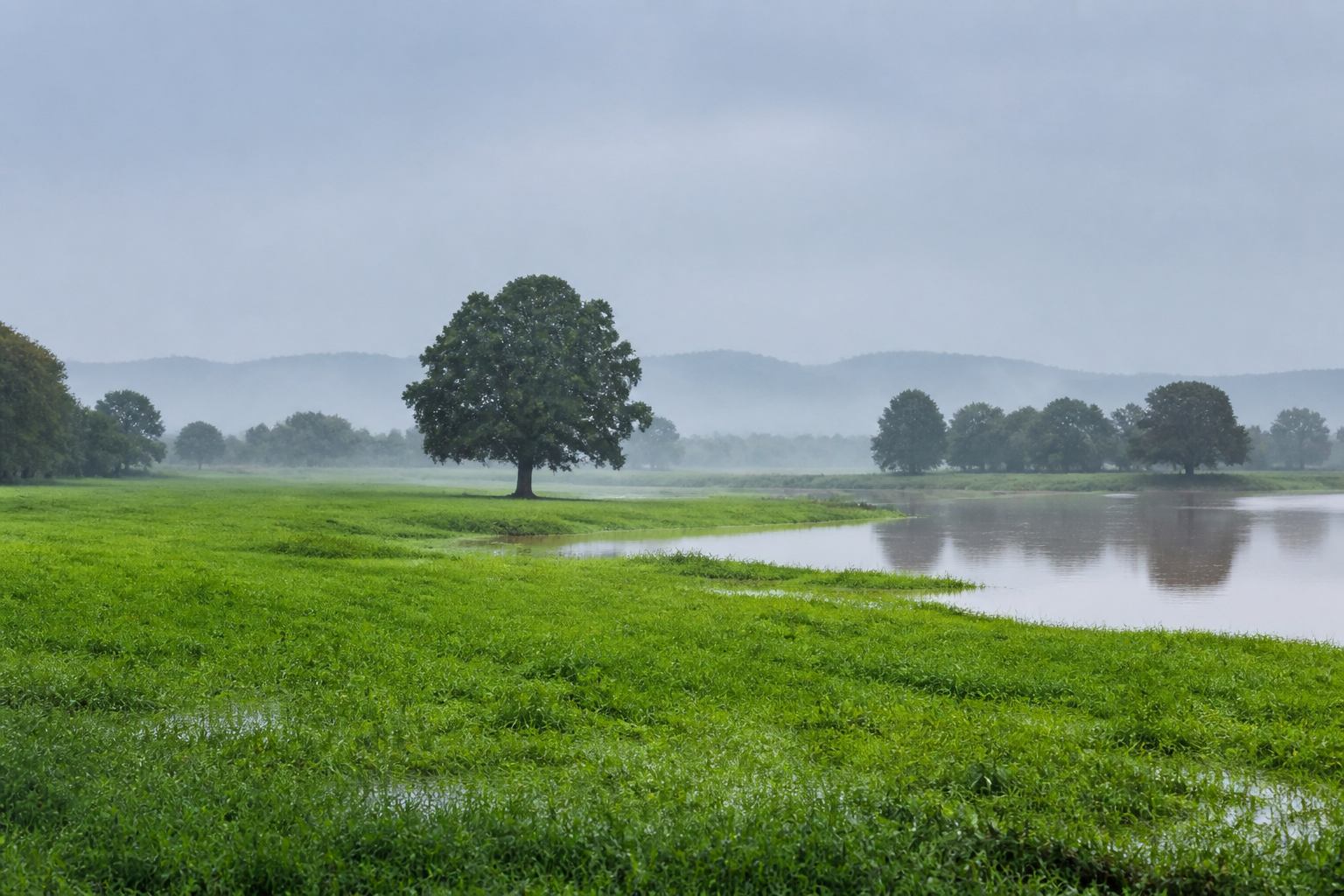
Flood meadows · river country
Green between the rivers
Along the Weser the landscape is not a lake plate. It is a contract: the river may occupy the foreland, the dike holds the town, and the bicycle takes the raised line in between.
What a flood meadow is for
Call it Vorland, call it floodplain grassland: the strip between summer bed and winter dike is agricultural and ecological at once. Cattle still write the height of the grass. In a wet spring the same field is a temporary lake with fence posts as a depth gauge. vantacd treats that oscillation as the point of the Weser chapter. You do not come to freeze a green postcard. You come to see a working flood system that still has room.
Nienburg sits on a terrace of brick and river trade. The useful visit is not a half-timbered inventory. Walk out until the square becomes a dike, until bakery traffic becomes a headwind, until the Weser is a brown moving meadow rather than a postcard mirror. Petershagen, further along the meanders, repeats the lesson with mills and wet woods as asides. Architecture stays secondary because the river is the plot.
The bicycle as a measuring tool
The Weser long-distance cycle line is famous for a reason that has nothing to do with trophies: it is almost cruelly honest about distance. Ten kilometres of meadow can feel like one painting until the wind turns. Surfaces are generally kind — asphalt, packed farm road — but the weather is the surface that matters. After a front, the foreland can be closed or simply foolish to cross. Stay on the built line. The Weser meadow ride in this guidebook is a one-day slice, not the whole river to the North Sea.
Trains serve Nienburg well. That is the correct start if you refuse a car. You can ride a meadow day and roll back to a platform without inventing a luggage problem. Combine with Rehburg’s oak roads if you want a contrast day of shade; the Weser itself will not give you a forest canopy.
Small towns as weather stations
Steinhude taught the lake edge; Nienburg teaches the river town that still smells of water when the wind is right. Local bread, a bicycle against a brick wall, a square that empties toward the dike — these are not lifestyle props. They are how people live when the interesting country begins one gate beyond the last house. Keep the camera on grass and sky. The gable is context.
Season on the foreland
- Water May — ditches full, grass electric, some paths soft.
- Silver July — long rides, cattle, a river that looks slower than it is.
- Bronze September — cooler starts, migratory traffic overhead, fewer swimmers anywhere in the district.
- Cloud December — graphic trees, empty benches, a Weser the colour of tea.
Linking lake country to river country
The five-day line in this hub treats the Weser as day four: after woods, before Dümmer. That order is not arbitrary. You leave the closed canopy of Rehburg-Loccum, spend a day in almost pure horizontal grass, then finish in reed. If you only have a weekend, choose either the lake circuit or this meadow day. Doing both in 48 hours turns the wind into an enemy.